Venice Time
Time in Motion
Our Italian doctor in Milan is fond of making the assertion, “Let’s look at the science.†Similarly, like a good scientist, Lucasian professor of mathematics at Cambridge University, Stephen Hawking, in his book: A Brief History of Time, after laboring for ten chapters with the science, offers this startling conclusion: The usual approach of science of constructing a mathematical model cannot answer the question of why there should be a universe to describeâ€. He then goes on to posit further, “Why does the universe go to all the bother of existing?†(174). These questions are telling, especially after Hawking began his book, “And our goal is nothing less than a complete description of the universe we live in†(13).
The Christian worldview has an appreciation for “the science.†But, it also realizes that to describe the universe from inside the universe can be precarious. In other words, not all secrets of the universe are given up at Cambridge or Princeton or MIT. To the Christian worldview, there is information which places the Lord outside the jurisdiction of the universe. Do we understand this? Reference Colossians 1:17, for example, where Christ is referred to as, sunesteken, in Paul’s Greek. This is translated, “…in him all things hold together (ESV). Hawking allows Guth to explain a GUT (grand unified theory) (see chapter 8, The Origin and Fate of the Universe):
Ventian Clocktower
“In an attempt to find a model of the universe in which many different initial configurations could have evolved to something like the present universe, a scientist at the Massachusetts Institute of Technology, Alan Guth, suggested that the early universe might have gone through a period of very rapid expansion. This expansion is said to be “inflationary,†meaning that the universe at one time expanded at an increasing rate rather than the decreasing rate that is does today†(127). The Christian portrayal of a GUT must involve the Hebrews 1:3 data, which places the ultimate source of energy and dynamics outside the system.
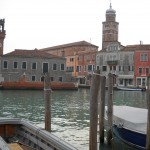
Isle of Murano
Now, when it comes to appreciating the above information, we are at once confronted with the ramifications to prayer. The God who answers prayer, being outside of the system per se, and yet concerned with the interior, is able to deliver (Ephesians 3:14-21). A second reason for relevance in these matters about a theology of Christ involves how the Lord is able to enter history. Throughout the biblical text there are invitations for participation in this, The Greatest Story Ever Told.
So, we give thanks today for solar physics and biological thriving (a biology and physics of Genesis); for gravitational force (attraction); and for atomic stability (coherence). This is My Father’s World!
 Job 42:1,2 reads: “Then Job answered the Lord and said, I know that you can do all things, and that no purpose of yours can be thwarted†(ESV).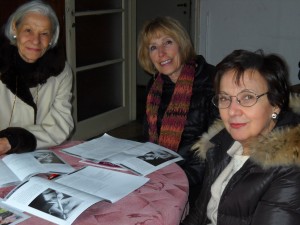
 In 2012, we held two campaigns in Milan.  There have been many military assaults upon Milan through the years, but this was about a kingdom of peace.  The Lord knows the work of Larry and Karen; Pat and Morissa.  Nearly 35 presentations were made between these individuals.  We appreciate every word spoken in the name of Jesus.  These are the kind of encounters recorded in the book of Acts (See 5:42)—a ceaseless sense of teaching, proclaiming, and caring about the spread of Jesus as the Christ. Thanks!
 He played slowly with delicate finesse.  Then, while admiring his instrumental work (because the lyrics are wanting), I looked down to see he had no legs (uhm).  His gift was undoubtedly despite his severe limitations.  Again, recently, in the cavernous chambers of the Metropolitana, I heard Mozart being played by a gifted violinist. We understand such beauty when it comes to music because of the immediate feedback. But, sometimes in the cause of Christ there are no immediate overtures or encores.  But, we believe that one day things will resolve when the books are opened.
  We understand that not long after the Italian tenor said those words he passed on into the great hereafter.   Someday, perhaps not long from now, we may like Pavarotti reflect back on our life and muse about what our gift has been.  And, like the music of Pavarotti, though he is gone, his music plays on.
 Milan (Acts 20:35; 2 Corinthians 9:11).  “Some people come into our lives and quickly go.  Some stay for awhile and leave footprints on our hearts.  And we are never, ever the sameâ€Â Â
Milan (Acts 20:35; 2 Corinthians 9:11).  “Some people come into our lives and quickly go.  Some stay for awhile and leave footprints on our hearts.  And we are never, ever the sameâ€Â   material position of the world is that it is strongly tilted toward a set of presuppositions which exclude outside forces (namely the Lord God) from the git-go.   That is why, when people sometimes state, “I believe in Science,” they are actually admitting to a higher power that is observable. An immediate problem here involves the nature of God being spirit, not chemical or a mere force field (John 4:24). So, end of discussion, right?
 anyway? For, to think as Jesus thought, to feel as he felt, and to see as he saw , we will need to acquire his set of beliefs (or, belief system). John 5:17 captures this assumption in a few words. Jesus believed that the Father was at work in the world, and that he was also involved in this magnum opus. When the gospel is preached and people respond in baptism, they are raised by the power of God out of the watery grave of Christian baptism. This is the Lord’s continuation of John 5:17. This is furthermore a call to believers to participate in the work of God (opera in Italian), by submitting to his plan. If it begins here, commencing in baptism, it takes the believer far away and yet nearer to the one who calls. This may be seen in Philippians 1:6, where the work of God in history has high continuity with John 5:17 and Colossians 2:12.
 exclusively to Columbus, Galileo, or Fermi. The sub-atomic level may appear random; neutrinos, for example. But, the speed of light is still a constant (300,00 kilometers per sec.). Dare to participate in the drama. Jesus will meet you there (Jn. 5:17; Col. 2:12; Phil. 1:6). Pronto?